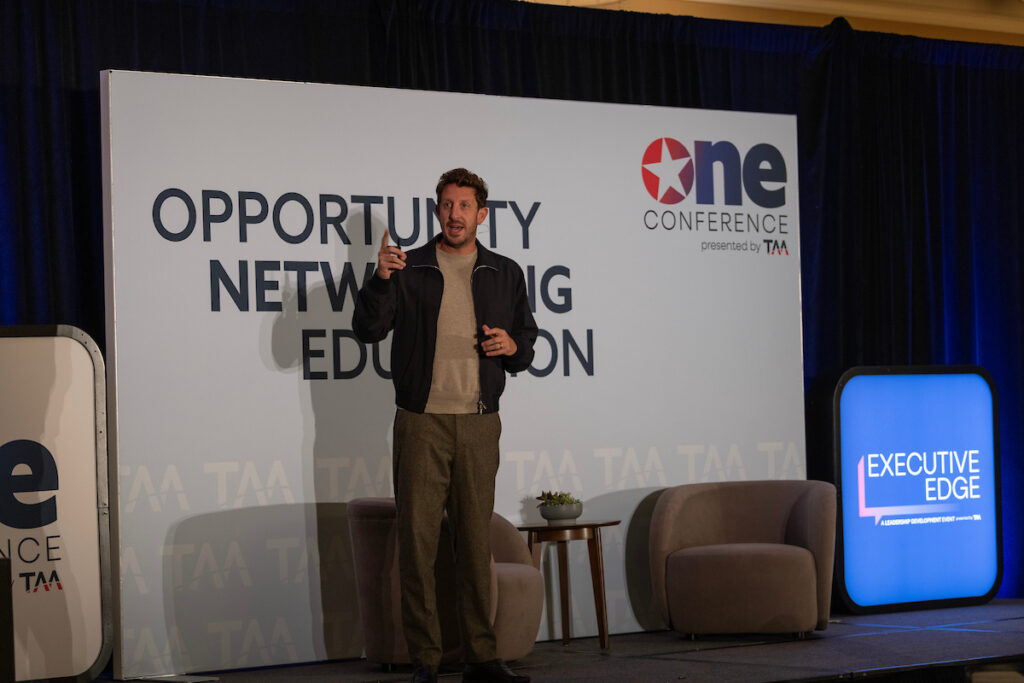
At this year’s Executive Edge session during the 2026 TAA ONE Conference, leaders gathered for a candid, forward-looking conversation on one of the most defining forces of our time: artificial intelligence. Led by Zack Kass, Advisor, Researcher, Keynote Speaker, and former Head of Go-to-Market at OpenAI, the session challenged attendees to think beyond technology itself and focus on something deeper: what kind of world we’re building, and who we’re becoming in the process.
AI Is Not a Tool. It’s Infrastructure.
One of Kass’s most important reframes came early in his talk: AI isn’t just another app, platform, or feature. It’s infrastructure. Just as electricity and the internet reshaped entire economies, AI is becoming a foundational layer that will power everything, from how we work to how we make decisions. And the pace of change is accelerating quickly.
Kass pointed to rapid advancements in recent years, noting that we are moving toward a future where machines can complete multi-step reasoning and even PhD-level research tasks. At the same time, the cost of intelligence is dropping dramatically, making powerful capabilities more accessible than ever before.
The implication for leaders? This isn’t something to adopt slowly or delegate. It’s something to understand, embrace, and strategically integrate.
The Rise of “Unmetered Intelligence”
Kass introduced a concept he’s been developing for years: unmetered intelligence, a world where access to intelligence is no longer scarce, but abundant. Historically, organizations competed by hiring the smartest people in the room. In the future, intelligence itself becomes available on demand, scalable, and embedded into workflows. This shift changes the game. Success will no longer hinge solely on what you know, but on how effectively you use intelligence to drive outcomes.
The Real Risks Aren’t What You Think
While much of the public conversation around AI focuses on job loss, Kass outlined four more nuanced and immediate risks leaders should be thinking about:
1. Idiocracy (The Decline of Critical Thinking)
As intelligence becomes more accessible, there’s a risk that individuals stop developing their own critical thinking skills. He referenced a blunt reality, that Gen Z is described as the first generation in modern history to not be smarter than the previous generation, and also less likely to read, less likely to ride a bike, and less likely to swim. Young people are not performing on an academic basis, but Kass was clear: this trend didn’t start with AI. It began in 2012 with the rise of smartphones and digital dependency years ago.
2. Dehumanization
Dehumanization is when an individual finds more interest in the digital or virtual world than the physical one. We’re already seeing an increase in isolation, anxiety, and disconnection as people spend more time in digital environments. Kass emphasized that we can’t just tell people to “get off their phones”. Rather, we need to reinvest and rebuild a physical world they want to be in, with parks, town halls and community centers.
3. Bad Acting
Violence is on the decline because we’ve made the physical world safe with surveillance, but online crimes are increasing, as that environment is not monitored. AI lowers the barrier for individuals to create harm at scale, particularly in digital environments. With online fraud already reaching staggering levels, this is a growing societal challenge. Kass cited that 9% of humans are anti-social and 4% of people are committing online crimes. So much so that $500B was lost to financial fraud in 2025.
4. Identity Displacement
Perhaps the most surprising insight: the biggest threat isn’t job loss, it’s identity loss. For generations, people have tied their identity to their profession. But as automation reshapes work, that connection is weakening. The question becomes: if you’re not defined by your job, then what defines you? Zack reminded us that your happiness comes from time with family and friends, community, places of worship, and being around the dining room table. He urged us to find purpose outside of work.
A More Optimistic Future, If We Choose It
Despite these risks, Kass delivered an ultimately optimistic message. AI has the potential to dramatically expand human capability. Today, one individual can accomplish exponentially more than in previous generations. To put numbers behind this, Zack explained that what one person can do today is 400% more than what one person could do in 1980 and 1 million percent more than what one person could do in 1800. The proof is in breakthroughs in medicine, science, and technology which are continually accelerating, but it’s not about what we can do if we are smarter. It’s about productivity. Entire industries could become more efficient and accessible. But progress isn’t just about productivity. It’s about how we use the time and capacity AI creates. As Kass put it, the real opportunity is to reduce suffering and increase joy.
What This Means for Leaders
For executive leaders, especially in industries like multifamily housing where people, communities, and experiences matter, this moment calls for both strategic clarity and human-centered leadership. Kass offered several practical ways to prepare:
1. Anchor Yourself
Define your mission, vision, and values. In a rapidly changing world, these become your constant.
2. Adapt Your Approach
The tools and tactics will continue to evolve. Leaders must stay flexible in how they operate and compete.
3. Learn How to Learn
The most valuable skill is no longer what you know, it’s how quickly you can acquire new skills and adapt.
4. Reinvest in the Human Experience
From building communities to fostering connection, leaders have a role to play in creating environments where people want to engage, both at work and beyond.
The Most Important Reminder: Be Human
In a room full of executives navigating growth, operations, and innovation, Kass closed with a message that cut through the noise: Go outside. Be human. Because in a world where machines can replicate intelligence, the qualities that matter most aren’t technical, they’re human: curiosity, empathy, courage, wisdom, humor, and morality. And perhaps his most powerful reminder of all: Today is the best day ever to be born—and tomorrow will be too.