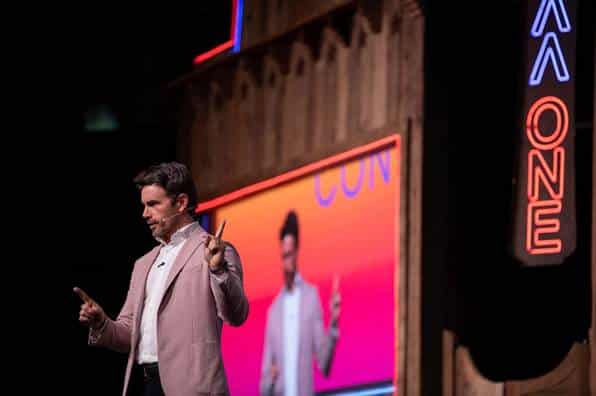
Seth Mattison opened the General Opening Session at TAA ONE in Fort Worth with a keynote that framed the Future of Work in plain terms: it’s about being adaptable, receptive, and open to change. Mattison, the founder of FutureSight Labs and a longtime advisor to brands like Mastercard, Johnson & Johnson, and the Dallas Cowboys, has spent nearly two decades helping organizations prepare for shifts in how work gets done. His case for why that work matters started for him during his youth on his fourth-generation family farm in Minnesota.
Mattison grew up working on his family’s land alongside his father, grandfather, and great-grandfather. Growing up as a farm kid, he said, instilled in him the value of hard work, humility, and the importance of leaving a personal imprint on everything he does. He traced the origin of his life’s work back to the early 80s, when his small Minnesota county watched family after family lose the farms they had held for generations. During that time, interest rates pushed toward 20 percent, inflation climbed into the mid-teens, and crop prices collapsed at the same moment land values fell out from under farmers. When the banks began calling in their loans, the community he grew up in unraveled. Losing a business is painful, Mattison said, but losing the land a family was entrusted with generationally carries a different kind of weight. That is what set him, as a teenager, on a path to spend his career helping people and organizations adapt to a changing world, because the cost of failing to adapt is not always measured in dollars.
To contrast with today’s inflection point, Mattison argued, it is not rates or inflation. Those numbers are tame compared to what farmers faced forty-five years ago. The external force reshaping multifamily and nearly every other industry is artificial intelligence. He acknowledged up front that the topic has been covered to exhaustion at conferences over the past year, then offered a different cut at it. Rather than another tools-and-demos overview, he walked through the human story of AI and where property management actually sits on the curve, using a simple four-stage continuum and scenarios pulled directly from day-to-day property operations.
The most practical takeaway of the session was Mattison’s continuum for locating a business on its AI journey:
- Chat: Asking AI a question, such as “What is a marketing plan?”
- Task: Asking the tool to build the (marketing) plan.
- Agent: Instructing AI to execute that plan across multiple workstreams independently.
- Autonomous: The frontier, where systems can spin up an entire company and operate it without human direction.
He grounded the continuum with a familiar multi-family maintenance scenario. At the chat level, the maintenance lead uses AI to troubleshoot a slow drain in a specific unit, referencing prior service history. At the agent level, the tool takes over preventative maintenance across the entire portfolio, scheduling work orders, sending reminders, logging completions, and escalating overdue items on its own. That capability, Mattison emphasized, is not theoretical. It exists right now, and the operators who learn to deploy it thoughtfully will shape the next decade of the multifamily industry.
When Mattison asked where the multifamily industry was on its continuum, the majority identified with the chat stage, both normal and reasonable. Yet while on the journey, the risk is to not harness the early stages, but to not fall behind, and to keep your eye on where the technology is heading next.
Mattison shared that in early February, a wave of agent-level AI tools reached the market, and public equities shed roughly $300 billion in a single day. By the end of the week, almost a trillion dollars in value had been erased from software stocks. Headlines labeled it the ‘SaaS Apocalypse.’ For the markets, the specifics mattered less than the signal: the ground is moving, and it is moving faster than most companies have accounted for or planned for.
The throughline from 1981 to 2026 is framed as a deliberate journey. Moving forward, however, his point is not that AI is dangerous or that property managers need to become technologists overnight, but that adaptation has, and always been, the defining task of leadership during a structural shift. The stakes, as he framed them, are not abstract, the shift underway now will reward operators who take it seriously and punish those who do not. They will show up in the careers of on-site teams, the experience of residents, and the long-term health of the portfolios built over decades. Seth Mattison’s session was not just another AI tech talk, but a clear-eyed look at the skill of adaptation.