
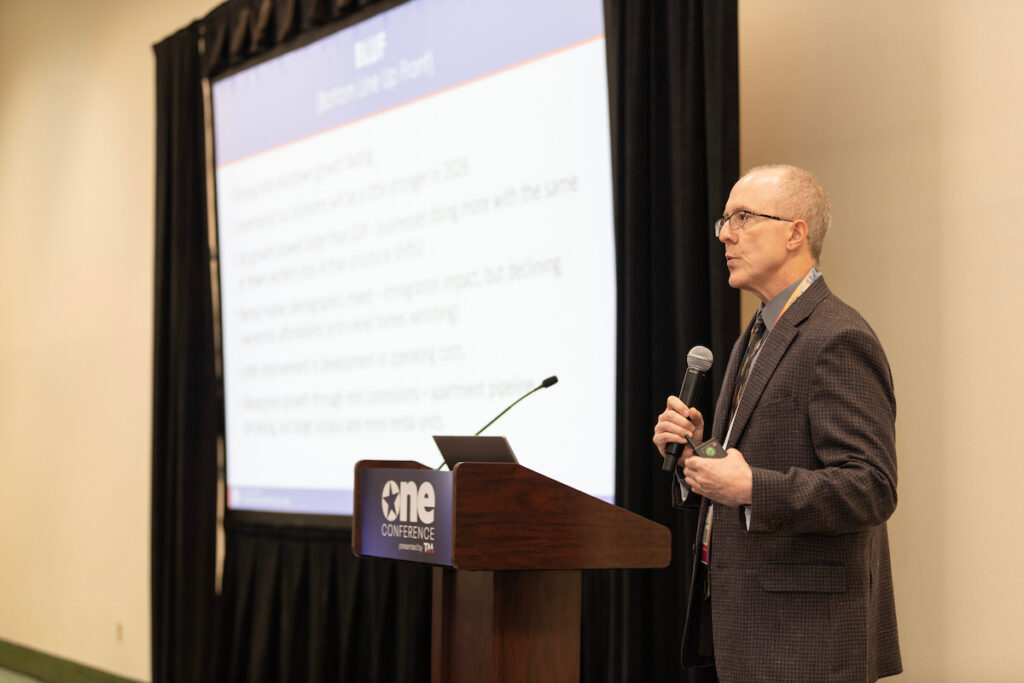
Daniel Oney, research director at the Texas Real Estate Research Center at Texas A&M University, opened his session at TAA ONE with a data-driven snapshot of the Texas rental market. Oney leads the Center’s work on analytical and forecasting frameworks for Texas commercial markets, and the picture he laid out for the room reflected that long view. Texas is still growing, still leading, still attracting people and capital, but the pace has shifted. Job growth has cooled, and the composition of that growth has changed in ways property managers should pay attention to.
Where the Jobs Are, and Aren’t
Healthcare, retail, leisure and hospitality continue to add jobs, but those are not the high-wage sectors that fill Class A units. Professional and business services, the engines that historically drove rental demand at the top of the market, are adding dollars but not headcount. Construction employment is also softening as the multifamily pipeline thins. The renter pool is still expanding, but it is expanding unevenly across price points.
Population Is Growing, but Migration Is Slowing
Texas continues to grow through traditional migration patterns, but foreign arrivals have dropped sharply year over year, which weakens multifamily demand in large international gateway markets like Houston and Dallas. The shift is also reshaping the typical household. There are fewer traditional families, more single-person households, fewer children, and fewer elderly residents than long-range projections anticipated. Each of those changes affects who is renting, what they want, and how long they stay.
The Affordability Gap
Oney walked through housing affordability by household type and showed how the pursuit of the American dream through homeownership now varies sharply by family composition. For many singles and couples without children, renting remains the rational choice well into higher income brackets. That is good news for occupancy, but it also means operators are competing harder for a renter who has more options and more leverage than five years ago.
Capital, Insurance, and Construction
Capital markets are repricing rather than collapsing. Insurance costs continue to climb and remain one of the most disruptive line items on Texas operating statements. On the supply side, the state is carrying a meaningful surplus of new units, with Austin and San Antonio absorbing the largest share of the overhang. Dallas-Fort Worth and Houston are closer to balance, with Houston in particular showing the discipline of a market that did not overbuild during the last cycle.
Where Rents Are Holding
Smaller Texas markets are sitting in what the speaker called the “green box,” with steady rent growth and healthier balance. The big four are mixed. Austin remains under pressure, San Antonio is working through its own surplus, and Dallas and Houston are roughly neutral. The single-family market is cooling alongside multifamily, which removes some of the pull-through pressure that had been pushing renters toward ownership.
The Outlook
Texas is in a reset, not a retreat. Operators who pencil deals on 2021 assumptions will be disappointed. Those who underwrite to current fundamentals, account for slower migration and a different household mix, and stay disciplined on expenses are positioned to do well. The demand is still here. The job is to meet the market that exists rather than the one that was.